



daily feed
India’s Manufacturing Revolution: From “Made in India” to Global Hub
By ashusharma02•Published: 2026-08-18•6 min read
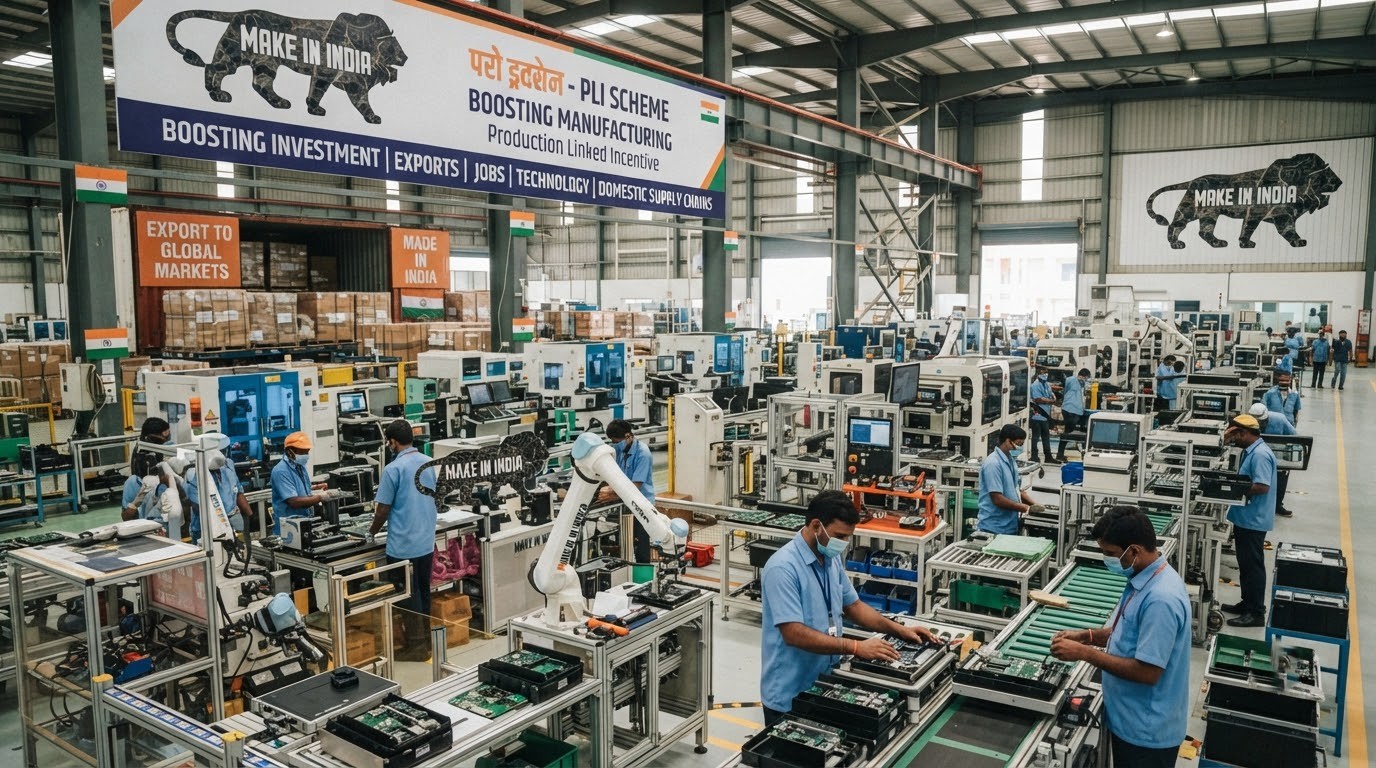
India is attempting to move from being primarily a large consumer market to becoming a major manufacturing base for the world. The “Make in India” initiative, launched in 2014, has gradually evolved into a broader strategy focused on domestic production, global supply chains, technology, exports and employment.
Manufacturing matters because it can create large-scale jobs beyond agriculture, raise productivity and strengthen economic growth. It also supports an ecosystem of logistics providers, suppliers, engineers, designers, financial institutions and small businesses. According to recent government data, manufacturing contributes approximately 16–17% of India’s GDP and employs more than 27 million workers. Manufacturing gross value added recorded a compound annual growth rate of 10.88% between 2022–23 and 2025–26.
The government’s Production Linked Incentive scheme is one of the main tools supporting this transformation. Covering 14 sectors, the Programme rewards companies for achieving production and sales targets. By March 2026, the schemes had attracted more than ₹2.40 lakh crore in investment, generated over ₹22.66 lakh crore in production and sales, and supported more than 14.15 lakh direct and indirect jobs. Cumulative exports under the scheme exceeded ₹15.2 lakh crore. manufacturing economic times.
Electronics, mobile phones, pharmaceuticals, automobiles, solar equipment, batteries, textiles and food processing are among the sectors that can help India expand its role in global value chains. Electronics are especially important because companies are diversifying production beyond traditional locations and seeking resilient supply networks.
Exports are another major objective. India’s merchandise exports reached approximately $44.24 billion in July 2026, compared with $36.98 billion a year earlier, while manufacturing output grew 7.8% in June. Sustaining this momentum will require competitive prices, reliable quality, faster ports, simpler regulations and deeper participation by Indian component suppliers.
Challenges remain. High logistics costs, uneven infrastructure, skill shortages, land and compliance issues, and dependence on imported technology can limit competitiveness. India must also ensure that manufacturing growth creates enough formal and well-paid employment rather than relying only on highly automated facilities.
The next phase of “Made in India” will therefore be judged not simply by the number of factories opened, but by how deeply Indian companies integrate into global supply chains. If investment, skills, innovation and infrastructure advance together, manufacturing could become one of the strongest foundations of India’s journey toward a developed economy.
Report Author
View Research Team →